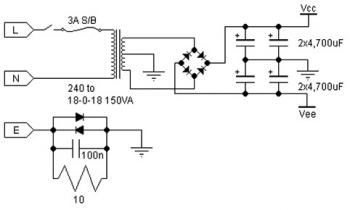
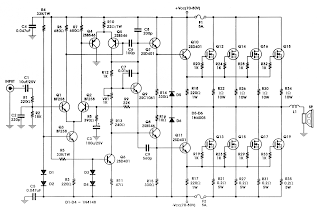
Showing posts with label power. Show all posts

Friday, January 10, 2014

Simple Dual 50V 5A Universal Power Supply Circuit Diagram

This is the simple Dual 50V/5A Universal Power Supply Circuit Diagram. Tl has two primaries and six secondaries; the two 120-VAC primaries and 6.3-VAC secondaries are in parallel. Modules A and are identical; hence, only Module A`s parts are called out. Module C is wired point-to-point on the IC3 heat-sink.

Dual 50V/5A Universal Power Supply Circuit Diagram

Dual 50V/5A Universal Power Supply Circuit Diagram

Read More..

Tuesday, December 24, 2013

LM4990 2 Watt Audio Power Amplifier with Selectable Shutdown Logic Level

The LM4990 is an audio power amplifier primarily designed for demanding applications in mobile phones and other portable communication device applications. It is capable of delivering 1.25 watts of continuous average power to an 8Ω BTL load and 2 watts of continuous average power (LD and MH only) to a 4Ω BTL load with less than 1% distortion (THD+N+N) from a 5VDC power supply. Boomer audio power amplifiers were designed specifically to provide high quality output power with a minimal amount of external components. The LM4990 does not require output coupling capacitors or bootstrap capacitors, and therefore is ideally suited for mobile phone and other low voltage applications where minimal power consumption is a primary requirement.


2 Watt Audio Power Amplifier with Selectable Shutdown Logic Level  2 Watt Audio Power Amplifier with Selectable Shutdown Logic Level

The LM4990 features a low-power consumption shutdown mode. To facilitate this, Shutdown may be enabled by either logic high or low depending on mode selection. Driving the shutdown mode pin either high or low enables the shutdown pin to be driven in a likewise manner to enable shutdown. The LM4990 contains advanced pop & click circuitry which eliminates noise which would otherwise occur during turn-on and turn-off transitions. The LM4990 is unity-gain stable and can be configured by external gain-setting resistors.
 Features

  • Available in space-saving packages: LLP, Exposed-DAP TSSOP, MSOP, and ITL
  • Ultra low current shutdown mode
  • Improved pop & click circuitry eliminates noise during turn-on and turn-off transitions
  • 2.2 - 5.5V operation
  • No output coupling capacitors, snubber networks or bootstrap capacitors required
  • Unity-gain stable
  • External gain configuration capability

  • User selectable shutdown High or Low logic Level
    Key Specification
    Improved PSRR at 217Hz & 1KHz  62dB
    Power Output at 5.0V, 1% THD+N, 4Ω (LD and MH only) 2W (typ)
    Power Output at 5.0V, 1% THD+N, 8Ω 1.25W (typ)
    Power Output at 3.0V, 1% THD+N, 4Ω 600mW (typ)
    Power Output at 3.0V, 1% THD+N, 8Ω 425mW (typ)
    Shutdown Current 0.1µA (typ)

    Applications

    • Mobile Phones
    • PDAs
    • Portable electronic devices
    Datasheets

    Source: http://www.ecircuitslab.com/2011/07/lm4990-2-watt-audio-power-amplifier.html

    Read More..

    Wednesday, May 29, 2013

    PWM Power Controller Circuit

    This is a circuit that can uses a 555 timer to generate a saw tooth voltage waveform across a capacitor, then compares that signal against a steady voltage provided by a potentiometer, using an op-amp as a comparator. The comparison of these two voltage signals produces a square-wave output from the op-amp, varying in duty cycle according to the potentiometers position. This is the figure of the circuit; 


    This variable duty cycle signal then drives the base of a power transistor, switching current and and off through the load. The 555s oscillation frequency is much higher than the lamp filaments ability to thermally cycle (heat and cool), so any variation in duty cycle, or pulse width, has the effect of controlling the total power dissipated by the load over time. Controlling electrical power through a load by means of quickly switching it on and off, and varying the "on" time, is known as pulse-width modulation, or PWM. It is a very efficient means of controlling electrical power because the controlling element (the power transistor) dissipates comparatively little power in switching on and off, especially if compared to the wasted power dissipated of a rheostat in a similar situation. When the transistor is in cutoff, its power dissipation is zero because there is no current through it. When the transistor is saturated, its dissipation is very low because there is little voltage dropped between collector and emitter while it is conducting current.

    PWM is a concept easier understood through experimentation than reading. It would be nice to view the capacitor voltage, potentiometer voltage, and op-amp output waveforms all on one (triple-trace) oscilloscope to see how they relate to one another, and to the load power. However, most of us have no access to a triple-trace oscilloscope, much less any oscilloscope at all, so an alternative method is to slow the 555 oscillator down enough that the three voltages may be compared with a simple DC voltmeter. Replace the 0.1 µF capacitor with one that is 100 µF or larger. This will slow the oscillation frequency down by a factor of at least a thousand, enabling you to measure the capacitor voltage slowly rise over time, and the op-amp output transition from "high" to "low" when the capacitor voltage becomes greater than the potentiometer voltage. With such a slow oscillation frequency, the load power will not be proportioned as before. Rather, the lamp will turn on and off at regular intervals. Feel free to experiment with other capacitor or resistor values to speed up the oscillations enough so the lamp never fully turns on or off, but is "throttled" by quick on-and-off pulsing of the transistor.

    Read More..

    Monday, May 13, 2013

    Regulated power expander


    Commercially available voltage regulator IC’s can deliver up to 1A output current. For example 78xx series regulators are available in different voltage ratings, but in any case the current should not exceed 1A.
     The transistor Q1 (2N 29055) used here has 5A current capacity. The resistor R1 is used to keep the current through regulator IC below 300mA. When the current through R1 increases the base current of Q1 (2N 29055) also increases &the load required load current flows through this transistor. By this way a current greater than the capacity of the regulator IC can be delivered to the load. The C1 is used to filter the ripples off the rectifier output.

    Notes.
    1. Assemble the circuit on good quality PCB.
    2. T1 can be a 230V primary,15V/1A secondary , step down transformer.
    3. If 1 A bridge is not available,make one using four 1N 4007 diodes.
    4. The series regulator IC should be selected according to the desired output voltage. * IC 7805 for 05V * IC 7806 for 06V * IC 7809 for 09V * IC 7812 for 12V
    Read More..

    Saturday, April 13, 2013

    Class AB Power Amplifier Circuit 30w Using Power Transistor


    30W Class AB power amplifier circuit diagram using power transistor. Set the above amplifier up by adjust the variable resistor R1 to maximum and R12 to zero. After this set up is done, the activate / turn on the amplifier. Adjust the R1 so that the measured output offset is between 30 and 100mV. Once set, adjust the R12 slowly to achieve a quiescent current of around 120mA. Keep checking the quiescent current as the amplifier heats up as it might change due to voltage drop changes in the output devices because of the heat. The heatsinks should be 0.6K/W or less for two amplifiers.

    Power supply circuit for 30W class AB power amplifier:
    power supply for 30W Class AB Power Amplifier Circuit
    30W Class AB Power Amplifier Circuit, Link
    Read More..

    Friday, April 12, 2013

    Constructing your own Dual Power Supply Rise

    Many occasions the hobbyist desires to have a simple, twin power provide for a undertaking. Existing power provides could also be massive both in energy output or bodily measurement. a easy Dual Power Supply is essential.For most non-critical softwares the very very best & simplest choice for a voltage regulator is the 3-terminal sort.The three terminals are enter, ground & output.

    The 78xx & 79xx sequence can present as much as 1A load current & it have on chip circuitry to prevent damage in the experience of over warmthing or excessive current. That is, the chip principally shuts down than blowing out. These regulators are cheap, easy to make use of, & they make it sensible to design a technique with lots of P C Bs during which an unregulated provide is brought in & regulation is finished in the neighborhood on each and every circuit board.

    This Dual Power Supply challenge gives a twin power supply. With the appropriate choice of transformer & 3-terminal voltage regulator pairs that you can be ready to basically construct a tiny energy provide delivering as so much as amp at +/- 5V, +/- 9V, +/- 12V, +/-15V or +/-18V. You require to supply the center tapped transformer and the 3-terminal pair of regulators you require:7805 & 7905, 7809 & 7909, 7812 & 7912, 7815 & 7915or 7818 & 7918.

    The person should pick the pair they wants for hellos phaseicular application.

    Note that the + & - regulators don't have to be matched: which you might for instance, use a +5v & -9V pair. However,the optimistic regulator should be a 78xx regulator, & the terrible a 79xx. They have in-built plenty of safety in to this venture so it ought to present loads of years of constant carrier.

    Transformer
    This Dual Power Supply design makes use of a full wave bridge rectifier coupled with a centre-tapped transformer. A transformer with a power output rated at as a minimum 7VA ought to be used. The 7VA score means that the most present which may also be delivered without overheating might be around 390mA for the 9V+9V tap; 290mA for the 12V+12V and 230mA for the 15V+15V. If the transformer is rated via output RMS-current then the price should be divided by way of one.2 to get the current which can be provided. For instance, in this case a 1A RMS can deliver 1/(one.2) or 830mA.

    Rectifier
    They use an epoxy-packaged four amp bridge rectifier with at the least a top reverse voltage of 200V. (Note the phase numbers of bridge rectifiers should no longer standardised so the number are completely different from totally different manufacturers.) For security the diode voltage ranking should be at the least to instances that of the transformers secondary voltage. The present rating of the diodes needs to be two occasions the maximum load present in an effort to be drawn.

    Filter Capacitor
    The goal of the filter capacitor is to easy out the ripple in the rectified AC voltage. Theres dual quantity of ripple relies on the price of the filer capacitor: the massiver the worth the smaller the ripple.The two,200uF is a suitable value for all the voltages generated the use of this undertaking. The other consideration in choosing the proper capacitor is its voltage ranking. The working voltage of the capacitor needs to be better than the height output voltage of the rectifier. For an 18V supply the height output voltage is one.4 x 18V, or 25V. So they have got chosen a 35V rated capacitor.

    Regulators
    The unregulated input voltage should all the time be greater than the regulators output voltage via at least 3V to be sure that it to work. If the enter/output voltage difference is bigger than 3V then the surplus doable have to be dissipated as heat. Without a heat sink three terminal regulators can dissipate about two watts. A easy calculation of the voltage totally differential occasions the current drawn will provide the watts to be dissipated. Over two watts a heat sink need to be presentd. If now not then the regulator will automatically flip off if the inner temperature reaches 150oC. For security it is always perfect to utilize a small heat sink even in case you don't suppose you are going to want.

    Stability
    C4 & C5 improve the regulators potential to react to unexpected adjustments in load current & to forestall uncontrolled oscillations.

    Decoupling
    The mono block capacitor C2 & C6 throughout the output offers high frequency decoupling which preserve the impedance low at high frequencies.

    LED
    Two LEDs are provided to point out when the output regulated power is on-line. You don't should make use of the LEDs in the adventure you don't require to. However, the LED on the negative side of the circuit does present a most load to the 79xx regulator which they found essential within the coursework of testing. The bad 3-pin regulators didn't like a nil load situation. They have presentd a 470R/0.5W resistors as the present limiting resistors for the LEDs.

    Diode Protection
    These give safety to notably against any again emf which can come again in to the facility provide when it provides energy to inductive tons. They additionally present additional short circuit offer protection toion in the case that the positive output is connected accidentally to the negative output. If this happened the standard current limiting shutdown in each and every regulator won't work as meant. The diodes will brief circuit on this case & offer protection to the two regulators.

    Read More..

    Wednesday, April 10, 2013

    Hydro Power Plan Principle

    Principal equipments of Water power Alternator in making electric energy is existence of turbine and generator. But at reality many equipments assists applied to make the electric energy. The equipments to assists most important in making electric energy for example; electric governor, AVR, inlet valve, etc. Principal source of power in producing electricity is water staying in cistern. Production Process or work in making visible electricity at residing in diagram under this;


    Drawing is upper depicting a production process beginning from current blocked accommodate and in cistern with number of a real big and supported by dam. Hereinafter the water is flown [by] through filter Tower Intake and trashrack steps into cast concrete pipe and pass gate chamber (door of in concrete) and steel iron pipe and hereinafter the pipe is ramified to become three divisions, namely two fast pipes (Penstock) to make a change from potential energy becomes kinetic dissociation energy of diatomic or kinetic and one pipes applied for irrigation passage. Tip of penstock or fast pipe there is Inlet valve which then is ramified to become two inlet valve commissioned to flow water towards turbine. Inlet applied as principal valve will be closed automatically or stopped if there is trouble or implementation of keeping at turbine. Following is one of drawing inlet valve applied in Water power Alternator

    Water having high dividing valve and speed or equally kinetic energy already happened, soon is flown towards burrs sudu remain to which will push road(street blade or runner attached at both turbines, so that happened mechanical energy in the form of revolution. Revolution which is mandatory defended by turbine 500 rpm with engine energy power equal to 9MW with water debit entering variation. The direction of revolution of Turbine is concurrent with needle hour/clock. Following is drawing from a turbine;


    Turbine consisted of some main component :


    a. Runner.

    The functions of this peripheral is to support revolution of turbine with energy that is enough when turbine shaft is not attributed to generator and made to assist from movement at axis.


    b. Shaft or peduncle.

    This peripheral made of the size wide to can give security and safety at operation in combination trap with generator peduncle at the time of its(the speed increases is finite at a speed of maximum revolution. this peduncle there is clutch that is unconnected with clutch at generator peduncle and that unconnected with runner.


    c. Turbine guide bearing (retainer of turbine rudder).

    Mode of action from this peripheral is lubricating oil is boosted up until making aperture so passing retainer surface ( 1) and ( 2) performance pumping because of speed difference between exteriors and inner of aperture ( 1)lubricant oil after successfully makes aperture ( 3), returns towards to place of lubricant until guide bearing ( 4). Lubricating oil will be made cool at place of its(the stock. From explanation to can be depicted with scheme following


    d. Wicket gates (door of screen).

    Each gates supported by two retainers of located viscid lubricant under washer and to canopy. Each upper peduncle also is completed with retainer of drive to arrest; detain weight from door and arrest; detains rising or lowering of from hydraulic drive. Each in gate will cover with itself his(its returns to position of closed if happened braking at the time of operation.


    e. Wicket gate bearing (retainer of door of screen).

    This peripheral consisted of wicket gate bearing, thrust bearing and bearing bush which is located under washer and to canopy. Compatible loading that can be applied within old is by preventing inlet water through in gate upper and lower canal water. Following be the surface.


    Add Image

    f. Shaft as of baffle device (equipments of peduncle sealing).

    Peduncle boom (shaft sleeve) protected quickly and cargo canopy (packing casing) attributed to principal canopy by retainer. Gland packing is placed between peduncles and cargo canopy. Water closed is functioning to arrange packing gland. Protective box completed with the long rings for lubricating oil. Accentual at as of baffle water must be ascertained in higher level condition from dividing valve at runner. Explanation is upper will seen at surface following.

    Rotary dissociation energy of diatomic yielded by turbine then applied to move each generator. Generator applied has 15 tri phase pole tides. Besides, this generator also is synchronous generator with position of axis vertical. In synchronous generator there is anchor coil and field coil at rotor. Because generator applied there is two, hence its (the erection is done in parallel. This meant to enlarge energy power capacities awakened. With generator parallel also functioned to take care of service continuity if there is generator which must be stopped, for example to take a rest. Generator Alternating Current works as according to the induction theory of electromagnetic. Simply explainable that when peripatetic conductor in a magnetic field, hence induced voltage will be yielded. In general generator consisted of magnetic field, dynamo, slip ring, brush, and in the form of resistance type. Generator rotor turned around by prime mover to yield rotary magnetic field at engine. This rotary magnetic field induces tri phase strain at generator stator coil. Rotor at synchronous generator basically is an big electromagnet. Generator rotor applied in this evocation is shoe pole type or pole salient. This caused by polar amounts at generator more than four poles.


    Besides also is caused by small revolution or less than 1500 rpm with capacities less than 10 MVA

    Water which has been applied to turn around turbine will go out returns to pass Tail Race for towards to rivers. Electric power yielded by each generator still very small namely 6,3 kV. Therefore, needed to boosts to become 150kV channeling efficiency to of dissociation energy of diatomic from generator towards load centre. Hereinafter the high voltage is divided to applies Switch Yard 150 kV at main generator watchman station then strain is transmission [by] towards main station and continued for channeling or interconnection to electric power system through High voltage passage cord 150 kV. Electric power yielded by generator and has been transmission is not able yet to directly applied by consumer. At this side strain alighted from transmission 150 kV to become distribution strain 20 kV. This process done by transformer step down in main watchman station. And will be degraded returns to become strain 380/220 Volts or 220/127 Volts by transformer mast to applied by consumer. The visible explanation at diagram following.


    Read More..

    Monday, April 8, 2013

    2 X 2 4 2 x 4 5 17 Watt Power Amplifier

    Amplifier circuit here is all based on the ic in the gains. Three IC TA7230P, TA7236P, TA7237AP is intregated circuit (IC) which was applied to the power amplifier. Each IC has a different output, different input voltage, all IC TA7230P, TA7236P, TA7237AP is manufactured by Toshiba.


    TA7230P, TA7236P, TA7237AP amplifier schematic
    TA7230P, TA7236P, TA7237AP amplifier schematic
    Read More..

    Sunday, April 7, 2013

    400W High Power Mosfet Amplifier

    High Power Amplifier Mosfet 400W . These amplifiers circuit can be used for virtually any application that requires high performance, low use Noise, distortion and excellent sound quality. Examples would be subwoofer amplifier should FOH stage Amplifiers, surround a canal a very powerful sound amplifier, etc. The 400W MOSFET-amplifier has four key stages of amplification. We are looking to start any Phase appropriate detail.

    Schematics Diagram 400W MOSFET Amplifier
    400watt high power amplifier


    As the name suggests All Q ,C and ZD the Bias and buffer phases. Its main goal is to provide a stable MOSFET Gates and offset voltage and the voltage buffer amplifier stage of the High Resource capacity. What would have without the phase response and the effect Slew rate is indeed very bad. The flip side of the coin is not the extra step Introduction of an additional dominant pole in the amplifier feedback loop.

    Also to what the name suggests this stage converts the voltage developed in the VAS and provides all the amps required to drive at 8 or 4 ohms. 2-ohm loads are possible for several minutes at a time. In fact, I have tested more than 1600 1kW amplifier Watts RMS at 2 ohms. But that would not be recommended as a long-term exposure at all. If it is higher than the figures of the STI-amp. Power to the AV amplifier 800 The components of the power for this amplifier are as follows, and are favored A channel or a power module alone. 1 toroidal transformer with a rating of 1kVA. Primary windings are made to fit.
    source:[link]
    Read More..

    LM1458 Using for Variable Amp Power Supply

    This regulated power supply circuit can be adjusted from 3 to 25 volt and is current limited to 2 amps as shown, but may be increased to 3 amps or more by selecting a smaller current sense resistor (0.3 ohm). The 2N3055 and 2N3053 transistors should be mounted on suitable heat sinks and the current sense resistor should be rated at 3 watts or more. Voltage regulation is controlled by 1/2 of a 1558 or 1458 op-amp. The Figure is shown in below;


    The 1458 may be substituted in the circuit below, but it is recommended the supply voltage to pin 8 be limited to 30 VDC, which can be accomplished by adding a 6.2 volt zener or 5.1 K resistor in series with pin 8. The maximum DC supply voltage for the 1458 and 1558 is 36 and 44 respectively. The power transformer should be capable of the desired current while maintaining an input voltage at least 4 volts higher than the desired output, but not exceeding the maximum supply voltage of the op-amp under minimal load conditions. The power transformer shown is a center tapped 25.2 volt AC / 2 amp unit that will provide regulated outputs of 24 volts at 0.7 amps, 15 volts at 2 amps, or 6 volts at 3 amps. The 3 amp output is obtained using the center tap of the transformer with the switch in the 18 volt position.
    Read More..

    Saturday, April 6, 2013

    Stabilized Regulated Power Supply Circuit

    Small and portable circuit, Very useful for Home-Laboratory


    This circuit of power supply, is very simple and easy to built, it can be assembled on a general-purpose PCB, finding its materials is very easy and cost-small. The output voltage is stabilized and is regulated in the region from 0V until + 15V dc, with biggest provided current 1 A. The regulation becomes with the P1. The Q1 is classic power transistor and it needs to be placed on a cool rib (Heatsink), when it works continuously in the region of biggest current it gets hot. The type of transformer is standard in the market.


    Circuit diagram:


    Stabilized Power Supply Circuit Diagram


    Parts:

    P1 = 330R-Potentiometer
    R1 = 560R-2W
    C1 = 2200uF-35V
    C2 = 100uF-35V
    C3 = 10uF-25V
    C4 = 220uF-25V
    C5 = 100nF-63V
    D1 = 18V-1.5W Zener
    Q1 = 2N3055 NPN Transistor
    T1 = 220VAC – 18V@ 1.5A
    BR1 = 4x1N4007 Diode Bridge
    SW1 = Mains On-Off Switch


    Read More..

    Friday, April 5, 2013

    Desktop PC Linear Power Supply Circuit


    Here’s a circuit for linear workbench desktop power supply circuit converts a high input voltage (12V) from the SMPS of a PC into low output voltage (1.25 to 9 volts). An adjustable three-pin voltage regulator chip LM317T (IC1) is used here to provide the required voltages. The LM317T regulator, in TO-220 pack, can handle current of up to 1 amp in practice. This is the figure of the design circuit;


    This figure shows the circuit of the desktop power supply. Regulator IC LM317T is arranged in its standard application. Diode D1 guards against polarity reversal and capacitor C1 is an additional buffer. The green LED (LED1) indicates the status of the power input. Diode D2 prevents the output voltage from rising above the input voltage when a capacitive or inductive load is connected at the output. Similarly, capacitor C3 suppresses any residual ripple. The circuit can be wired on a common PCB. After fabrication, enclose the circuit in a metallic cover. Then open the cabinet of your PC and connect the input line of the gadget to a free (hanging) four-pin drive power connector of the SMPS carefully. Connect a standard digital voltmeter in parallel with the output leads to accurately set the desired voltage with the help of variable resistor VR1. You can also use your digital multi meter if the digital voltmeter is not available. Switch on S1 and set the required voltage through preset VR1 and read it on the digital voltmeter. Now the power supply is ready for use.
    Read More..