Showing posts with label simple. Show all posts

Friday, January 10, 2014

Simple Dual 50V 5A Universal Power Supply Circuit Diagram

This is the simple Dual 50V/5A Universal Power Supply Circuit Diagram. Tl has two primaries and six secondaries; the two 120-VAC primaries and 6.3-VAC secondaries are in parallel. Modules A and are identical; hence, only Module A`s parts are called out. Module C is wired point-to-point on the IC3 heat-sink.

Dual 50V/5A Universal Power Supply Circuit Diagram

Dual 50V/5A Universal Power Supply Circuit Diagram

Read More..

Sunday, December 22, 2013

Simple Digital Switching System

This circuit can control any one out of 16 devices with the help of two push-to-on switches. An up/down counter acts as a master-controller for the system. A visual indication in the form of LEDs is also available.  IC1 (74LS193) is a presettable up/ down counter. IC2 and IC3 (74LS154) (1of 16 decoder/demultiplexer) perform different functions, i.e. IC2 is used to indicate the channel number while IC3 switches on the selected channel.

Digital Switching System Circuit Diagram :
Digital Switching System-Circuit Diagram

Before using the circuit, press switch S1 to reset the circuit. Now the circuit is ready to receive the input clock. By pressing pressing switch S2 once, the counter advances by one count. Thus, each pressing of switch S2 enables the counter to advance by one count. Likewise, by pressing switch S3 the counter counts downwards.

The counter provides BCD output. This BCD output is used as address input for IC2 and IC3 to switch one (desired channel) out of sixteen channels by turning on the appropriate triac and the corresponding LED to indicate the selected channel.  The outputs of IC3 are passed through inverter gates (IC4 through IC6) because IC3 provides negative going pulses while for driving the triacs we need positive-going pulses. The high output of inverter gates turn on the npn transistors to drive the triacs. Diodes connected in series with triac gates serve to provide unidirectional current for the gate-drive.

Sorce : www.ecircuitslab.com/2012/08/digital-switching-system.html
Read More..

Friday, May 31, 2013

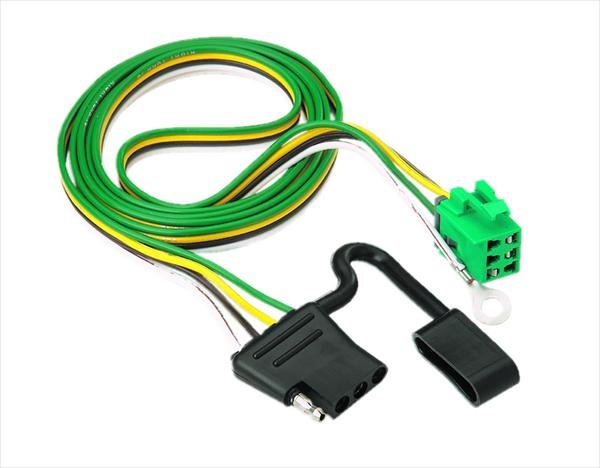
Trailer Wiring Harness Flat Connector Simple

Trailer Wiring Harness on Tow Ready   118240   Chevy Express 1996 2003 Trailer Wire Harness
Tow Ready 118240 Chevy Express 1996 2003 Trailer Wire Harness.


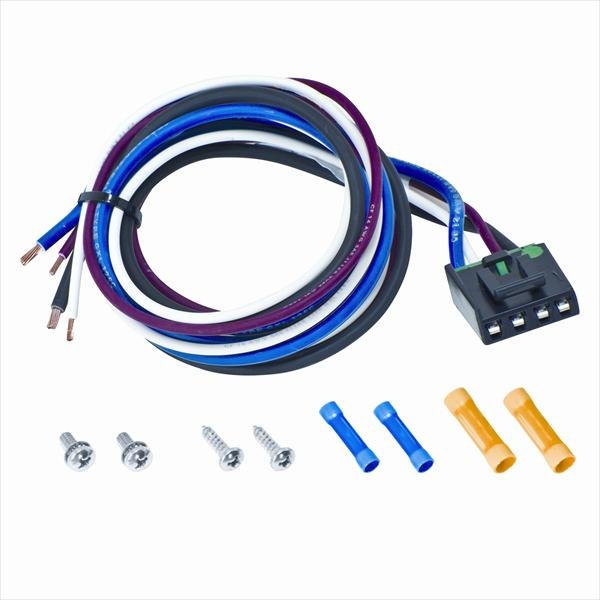
Trailer Wiring Harness on Tekonsha   7894   Universal Trailer Brake Control Wire Harness
Tekonsha 7894 Universal Trailer Brake Control Wire Harness.


Trailer Wiring Harness on Information About This 2006 Ford Fusion Trailer Wiring Harness Here
Information About This 2006 Ford Fusion Trailer Wiring Harness Here.


Trailer Wiring Harness on Draw Tite   118245   Lexus Lx 2001 2011 Trailer Wire Harness
Draw Tite 118245 Lexus Lx 2001 2011 Trailer Wire Harness.


Trailer Wiring Harness on Trailer Hitch Wiring Harness   Nissan Murano   Nissan Murano Forums
Trailer Hitch Wiring Harness Nissan Murano Nissan Murano Forums.


Trailer Wiring Harness on Jeep Liberty Trailer Wiring Harness T One Adapter Curt 55382   Ebay
Jeep Liberty Trailer Wiring Harness T One Adapter Curt 55382 Ebay.


Trailer Wiring Harness on This Trailer Wiring Harness Has A Flat  4 Way Connector And Its Simple
This Trailer Wiring Harness Has A Flat 4 Way Connector And Its Simple.


Trailer Wiring Harness on Toyota Corolla 2003 2010 Trailer Wiring Harness Kit Parts For Sale
Toyota Corolla 2003 2010 Trailer Wiring Harness Kit Parts For Sale.


Trailer Wiring Harness on Mariner Trailer Hitch Wiring Harness   Amazon Com   Automotive
Mariner Trailer Hitch Wiring Harness Amazon Com Automotive.


Trailer Wiring Harness on Trailer Wiring 2 Jpg  13 7 Kb  43 Views
Trailer Wiring 2 Jpg 13 7 Kb 43 Views.


Read More..

Tuesday, April 30, 2013

Simple Stereo VU Meter

I like to see lights move to music. This project will indicate the volume level of the audio going to your speakers by lighting up LEDS. The LEDS can be any color so mix them up and really make it look good. The input of the circuit is connected to the speaker output of your audio amplifier. You want to build two identical units to indicate both right and left channels. The input signal level is adjusted by the 10k ohm VR. If you wish to make a very large scale model of this unit and hang it on your wall there is an optional output transistor that can drive many LEDS at once. The unit I built drove three LEDS for each output. The sequence of the LEDS lighting are as follows Pin 1, 18, 17, 16, 15, 14, 13, 12, 11, 10.


Read More..

Saturday, April 13, 2013

Simple Gate Alarm

Description:
A cheap and easy gate alarm comprised of a single CMOS Integrated Circuit.


Figure 1 characterizes a low cost and simple Gate Alarm, that is supposed to run off a small universal AC-DC energy supply.

IC1a is a fast oscillator, and IC1b a gradual oscillator, which can be blended through IC1c to emit a high pip-pip-pip warning sound when a gate (or window, and so on.) is opened. The circuit is meant no longer so much to sound like a siren or warning tool, but quite to present the impression: \"You were now noticed.\" R1 and D1 may be ignored, and the value of R2 perhaps decreased, to make the Gate Alarm sound more like a warning software. VR1 adjusts the frequency of the sound emitted.

IC1d is a timer which lead tos the Gate Alarm to emit some 20 to 30 further pips after the gate has been closed again, sooner than it falls silent, as if to say: \"Im more clever than a easy on-off tool.\" Piezo disk S1 may be changed with a LED if preferred, the LED being wired in collection with a 1K resistor.

Figure 2 shows how an bizarre reed swap may be transformed to close (a \"normally closed\" swap) when the gate is opened. A continuity tester makes the work straightforward. Note that many reed changees are refined, and subsequently wires that are soldered to the reed change should not be flexed at all near the swap. Other forms of swapes, one of theses microswitches, can be used.
Read More..

Friday, April 12, 2013

Simple Mixer with 4 Input

Here the simple mixer with 4 input and 2 op-amps:

Simple Mixer with 4 Input Circuit diagram :


A basic mixer suitable for mixing microphones or even effects outputs. The overall gain from input to output is one if the pot related towards the input is full up. You can make this a net gain of ten (or any other reasonable gain) by reducing the input resistor towards the second op amp. 10K in this position gives a gain of ten, or 20db. In case you are mixing effects outputs that have an output level control constructed into them, you are able to dispense using the input level controls, or make some have level controls, some not. Audio taper pots are possibly much better, but linear will do the job.

For the op amps, choose a JFET input dual or singles, such as from the National Semi LF3xx series, or something such as the TL072 or TL082.
Read More..

Simple Audio Peak Detector

This audio peak detector allows a pair of stereo channels to be monitored on a sin-gle LED. Identical circuitry is used in the left and right channels. Use is made of the switch-ing levels of Schmitt trigger NAND gates inside the familiar 4093 IC. The threshold level for gate IC1.A (IC1.B) is set with the aid of preset P1, which supplies a high-impedance bias level via R2 (R1). 

Circuit diagram :
Simple Audio Peak Detector-Circuit-Diagram
Simple Audio Peak Detector Circuit Diagram
When, owing to the instantaneous level of the audio signal superimposed on the bias voltage by C3 (C2), the dc level at pins 1 and 2 (5 and 6) of the Schmitt trigger gate drops below a certain level, the output of IC1.A (IC1.B) will go High. This level is copied to the input of IC1.C via D2 (D1) and due to the inverting action of IC1.C, LED D3 will light. Network R3-C1 provides some delay to enable very short audio peaks to be reliably indicated. Initially turn the wiper of P1 to the +12 V extreme — LED D3 should remain out. 

Then apply ‘line’ level audio to K1 and K3, preferably music with lots of peaks (for example, drum ‘n bass). Carefully adjust P1 until the peaks in the music are indicated by D3. The circuit has double RCA connectors for the left and right channels to obviate the use of those rare and expensive audio splitter (‘Y’) cables. 


Source by streampowers
Read More..

Thursday, April 4, 2013

How to Build a Simple Electronic Incubator Thermostat


An electronic incubator thermostat circuit shown in this article is not only simple to build but is also easy to set and acquire exact tripping points at various different set temperature levels. The setting may be completed through two discrete variable resistors. The sensing range is quite good from 0 to 110 degrees Celsius.

Switching a particular load at different threshold temperature levels doesn’t necessarily need complex configurations to be involved in an electronic circuit. Here we discuss a simple construction procedure of an electronic incubator thermostat.


This simple electronic incubator thermostat will very faithfully sense and activate the output relay at different set temperature levels from 0 to 110 degree Celsius.
The conventional electromechanical temperature sensors or thermostats are not very efficient due to the simple reason that they cannot be optimized with accurate trip points.
Normally these types of temperature sensor or thermostats fundamentally use the ubiquitous bimetal strip for the actual tripping operations. When the temperature to be sensed reaches the threshold point of this metal, it bends and buckles.
Since the electricity to the heating device passes through this metal, it’s buckling causes the contact to break and thus power to the heating element is interrupted - the heater is switched off and the temperature starts falling. As the temperature cools, the bimetal starts straightening to its original form. The moment it reaches its previous shape, the electricity supply to the heater is restored through its contacts and the cycle repeats.
However, the transition points between the switching are too long and not consistent and therefore not reliable for accurate operations.
The circuit presented here is absolutely free from these drawbacks and will produce comparatively high degree of accuracy as far the upper and the lower tripping operations are concerned.


Parts List

R1 = 2k7,
R2, R5, R6 = 1K
R3, R4 = 10K,
D1---D4 = 1N4007,
D5, D6 = 1N4148,
P1 = 10K,
VR1 = 200 Ohms, 1Watt,
C1 = 1000uF/25V,
T1 = BC547,
T2 = BC557,
IC = 741,
OPTO = LED/LDR Combo.
Relay = 12 V, 400 Ohm, SPDT.


Circuit Description

We know that every semiconductor electronic component changes its electrical conductivity in response to the varying ambient temperature. This property is exploited here to make the circuit work as a temperature sensor and controller.
Diode D5 and transistor T1 together form a differential temperature sensor and interact greatly with each other with changes in the respective surrounding temperature.
Also since D5 acts as the reference source by staying at the ambient temperature level should be kept as far as possible from T1 and in open air.
Pot VR1 may be used externally to optimize the reference level set naturally by D5.
Now assuming D5 is at a relatively fixed temperature level (ambient), if the temperature in question around T1 starts rising, after a particular threshold level as set by VR1, T1 will begin to saturate and gradually start conducting.
Once it reaches the forward voltage drop of the LED inside the opto-coupler, it will start glowing correspondingly brighter as the above temperature rises.
Interestingly as the LED light reaches a particular level, further set by P1, IC1 picks this up and instantly switches its output.
T2 along with relay also respond to the IC’s command and respectively actuate to trip off the load or the heat source in question.
How to go About with the Opto-Coupler?

  It’s very simple. Cut a piece of general purpose board about 1 by 1 inch.
Bend the LDR leads near its “head.” Also take a green RED LED, bend it just as the LDR (See figure and Click to Enlarge).
Insert them over the PCB so that the LED lens point is touching the LDR sensing surface and are face to face.
Solder their leads at the track side of the PCB; do not cut off the remaining excess lead portion.
Cover the top with an opaque lid and make sure its light proof. Preferably seal off the edges with some opaque sealing glue.
Let it dry. Your home made opto-coupler is ready and may be fixed over the main circuit board with its leads orientations done as per the electronic incubator thermostat circuit schematic.

Read More..